Digital Marketing Specialist, Social Media Consultant,
and Tech Geek at Heart

Home >

Posts tagged as:

college

Choice of Form: Two Legal Seminars As Social Media

December 2, 2008

This is a guest post by search engine optimization expert Gab Goldenberg, who actually spends a good chunk of his time in a classroom: he’s a law student!

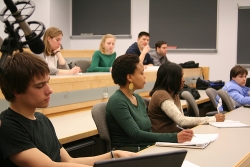
I’m taking two seminar courses at school this term, and they each resemble a particular form of social media. A seminar is different from a regular course in that it necessarily involves interaction with the students — a seminar is to a regular lecture course as web 2.0 is to web 1.0. What is interesting about these two seminars I’m taking is the difference in the teaching styles and the relationships that result.

Professor Daniel Jutras’ classes begin with him and/or students covering some current events relating to the seminar’s topic. Then, Professor Jutras lectures for about an hour, covering the principal ideas in the week’s readings. We pause for 10 minutes, and when we return, the class asks questions or makes comments, to which Professor Jutras responds.

I see this seminar as a blog. The blogger (Professor Jutras) posts his ideas, occasionally throws in some editorial and takes some light, widget-fed microblogging (the current events some students share). As an aside, Professor Jutras makes it obvious when he’s editorializing, which makes it easy to take it for what it’s worth: an informed opinion, but not necessarily fact.

Read the full article →

College Statistics 2006: MySpace, Facebook, YouTube, Google!

December 1, 2006

According to the 2006 GenX2Z Anderson Analytics survey (PDF link), the top five websites of choice by college students are:

    Googleplex Hotness

  1. MySpace (13% of visits, a 258% increase from 2005)
  2. facebook.com (11.5%, a 41% increase from 2005)
  3. youtube.com (4.5%, with no data from 2005 recorded)
  4. collegehumor.com (3.7%, a 61% decrease from 2005)
  5. Google.com (3.7%, a 13% decrease from 2005)

That puts Google, Inc. in two of the top ten spots, making any community-oriented website envious of the search engine that also seems to be faring quite well in social networking too.

Does it come as any surprise that Google is the employer of choice by college students? According to another recent survey on CollegeGrad.com, almost half — 49% — of students would rather work at Google than Microsoft (29%) or Yahoo (12%).

Could they score a job? Maybe, if Google really is getting easier on hiring.

So — why do college students want to work at Google?Google Ping-Pong

Read the full article →

Gmail to Replace University Email System?

October 24, 2006

The Georgetown Hoya reported today that the university is considering a Google alternative to their internal mail system due to the Georgetown mail servers being unreliable.

The new system would run off the Google Apps for Education platform, enabling students to use … essentially, Gmail. Emails would be routed through Google’s server, preventing issues such as bounced messages or internal downtime or outages.

Will this have any ramifications to academic freedoms that students in well-known universities are entitled to? Will this be a breach of security or violation of privacy? We all know that Google does a good job based on data, but will Google be doing more than just “hosting” email?

Granted, from a system administration standpoint, Google Apps for Education does sound tempting. But it is an entirely different issue if the data that resides on a student account is “used” in any way.

Having just graduated from college myself (I still maintain my college email account having previously worked at my college computing), I know that I need not be concerned about the security of my college email account. The only people who would be able to access my account are those who have root access to the server upon which my mail resides. I know that my university isn’t data mining my mail, looking for ways to optimize for the “best user experience,” which is something that Google takes pride on offering to the public.

Read the full article →