Digital Marketing Specialist, Social Media Consultant,
and Tech Geek at Heart

Home >

Posts tagged as:

spam

Building Trust: A Relationship is Not a Newsletter Opt-In

December 8, 2009

In my social media etiquette handbook, which is easily my most referenced post of the past year, I allude to a problem that has become increasingly more prominent in social media circles and on social media networks and sites. In the post, I shared my don’ts of social networks, and to that point, I added the following rule for LinkedIn:

Gathering all the email addresses of users you are connected to — even locating email addresses of LinkedIn Group managers — and utilizing this mailing list to promote your own company or service off-site. In a specific case, I manage a few LinkedIn groups so my email address is far more visible on the site than I’d like. I’m not connected to the LinkedIn individual who spammed me, but he still took the liberty to use my email address for his personal gain in a completely unsolicited fashion. Perhaps this individual lost sight that LinkedIn is a professional network and not a spam facilitator. Even so, recipients should still be required to opt in.

Read the full article →

The Nightmare Public Relations Professional and How to Stop Him

September 29, 2009

This is a guest post I wrote for new media and PR expert Brian Solis, but I also wanted to share it with my readers. Brian Solis and Deirdre Breakenridge just published an excellent book, Putting the Public Back in Public Relations. It’s a must read for any PR professional moving into or active in this space.

As bloggers, we’ve all experienced it: the completely off topic pitch. After pouring blood, sweat, and tears into our blog that clearly is known for addressing a specific subject matter, we get an email from a public relations agency that takes us for someone completely different. Where do they come off doing that?

A few months ago, Brian Solis talked about an off-topic pitch about a social network for plants. (Somehow, I think nature lovers would be more interested in socializing shrubbery.) I’m sure you can relate. With some of these pitches, I scratch my head. With others who address me as Jennifer or Dakash, I wonder if these individuals representing both small and large companies really realize that their lack of research reflects poorly on their clients.

Read the full article →

The Ultimate Social Media Etiquette Handbook

December 10, 2008

Hi Bing visitors! Like this post? Hire me for social media consulting.

Social media mimics real relationships — in many cases. Would you do the following within real face-to-face relationships?

  • Jump on the friendship bandwagon without properly introducing yourself?
  • Consistently talk about yourself and promote only yourself without regard for those around you?
  • Randomly approach a friend you barely talk to and simply ask for favors — repeatedly?
  • Introduce yourself to another person as “Pink House Gardening?”

If you answered yes to any of these questions, you may need a refresher course on social media etiquette — and perhaps real-life etiquette also. Here are some egregious sins that you must not perform on social media sites. Avoid these violations and learn how to manage and maintain online relationships on a variety of popular social media sites.

Facebook

  • Adding users as friends without proper introductions. If you’re looking to make friends, tell people who you are. Don’t assume they know you — especially if they, well, don’t.
  • Abuse application invites and consistently invite friends to participate in vampire games. Many call this spam.
Read the full article →

Spamming Social Networks is a No-No

June 21, 2007

Today, DazzlinDonna wrote a very timely piece on social network spammers. It’s been so applicable lately as I’m beginning to be befriended by anyone and everyone on just about every social network.

In the past several weeks, my Twitter accounts have been friended up by porn solicitors and people looking to market websites that I’m just not interested in. My Flickr friends, on the other hand, are only friending up people who are obviously female. And let’s not forget MyBlogLog spam, though it’s gotten much better lately, and Orkut spam.

I got my first bit of Facebook spam in December. Today, it overflowed to the friend realm. These look like link exchange emails. Here’s my most recent friend request:

Hi happy
nice meet to you
i am randomly invitation through your friend
i want to have a good friend
thank you.

Thanks… but uh, no thanks.

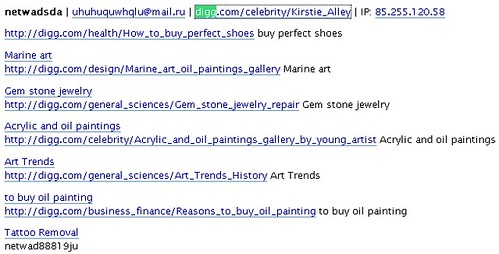
(On a similar note, I got a bit of Digg spam lately too in the form of comments on my blog:

Really Annoying Digg Spam

Really, thanks for spamming your story. Most stories on Digg, however, get promoted within the initial 24 hours, not 5 days later.

Read the full article →

Should Domain Name Registration Information Be Hidden?

March 22, 2007

Since I’m covering a lot more of the latest news lately, I noticed yesterday that there is proposed legislation that will possibly anonymize domain registration information. The reason? Spam. Spammers are apparently accessing WHOIS information and using this information to send individuals unsolicited messages. The proposed legislation would allow “domain name registrants would be able to list third-party contact information in place of their own.”

Note that I emphasized “apparently.” While I’ve seen this practice happen in the past in minute amounts, I’m pretty confident that spammers are not using the WHOIS database for the kind of spam that plagues our everyday lives. Spammers have bots that crawl regular SERPs for that. Furthermore, most WHOIS query databases have limitations on the number of domains you can look up in any given time.

Additionally, once your email address is out there, it’s out there. Perhaps, if you choose to hide it later, it won’t be accessed by new generation spammers (unless they buy an old list), but people will have those email addresses until you change to a new one (and protect that new one). The only spam I’ve received related to any domain names I’ve owned are from domain “hijacker” companies, like DROA (the Domain Registry of America), companies who think it’s perfectly fine to con users into believing that their domain is about to expire — so let’s go renew it with another registrar — me! (Do I sound frustrated?)

Read the full article →